
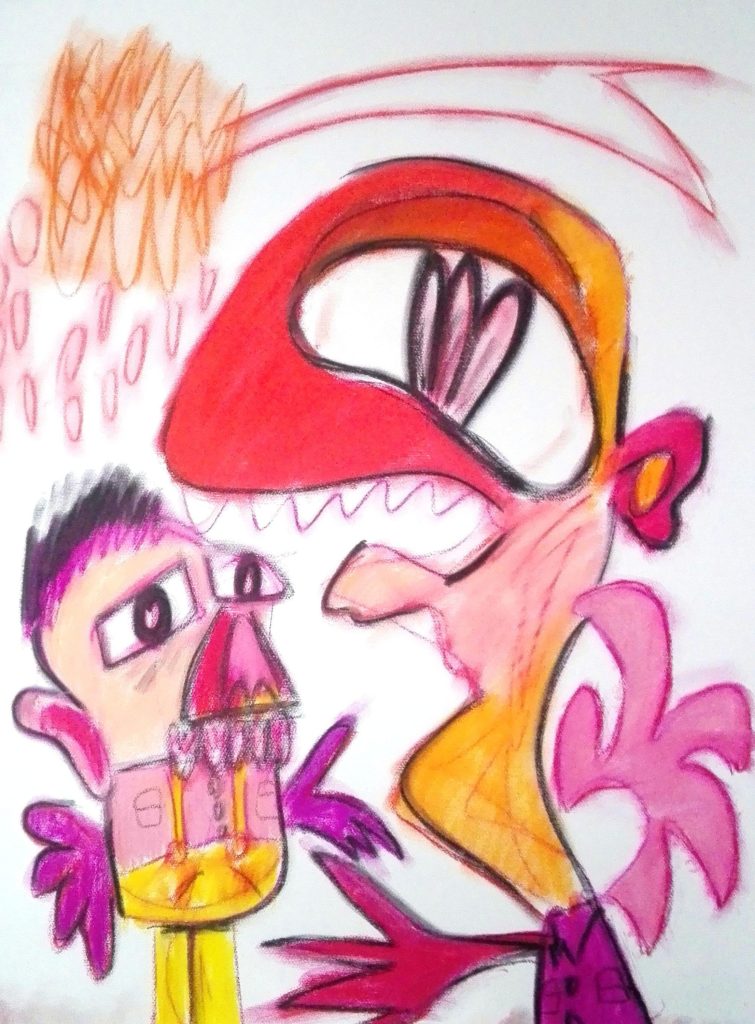

My style is Neo-Expressionism within Contemporary Art, with which I identify. I paint portraits of characters with vivid and pure colors, especially with wax on paper, the technique with which I express myself best. I try to deepen and find everything that interests me in the human being and search for the soul of each one so that the spectator sees themselves reflected in each painting.
Read a Q&A with José Antonio Higuero
Talk to us about your work featured here. What are the main themes and ideas you explore in it?
My works are about human beings, about their psychology. I try to reflect their inner selves in them. And they provoke in the viewer a reflection on what we are and how we think about people. That's why almost all I paint are faces of characters, which express their inner motivation.
Describe your creative process.
I do oil and acrylic paintings on canvas, and above all drawings with crayons on paper, which is the technique I like best and with which I express myself best. Above all I paint figures of invented characters, with which I try to give a vision of the people of today and to unite the tradition of painting with the new visualisations of modern man. And I also use other techniques such as watercolour, gouache, charcoal, charcoal pencil, sanguine, etc. I prefer not to abuse the use of excessive stains and strokes and that my works are clean, that they can be seen at a glance, with a first impact and that the spectator can then enjoy, more calmly, observing the forms of the painting or drawing carefully. It is the first impression that counts. I want my works to ‘enter through the eyes´.
What are the main influences and inspirations behind your art?
The main influences of my art are Outsider art, and the artists Pablo Picasso, Jean-Michel Basquiat, Karel Appel, Francis Bacon, Matt Sesow and Antonio Saura.
What do you consider the strongest aspect of your work?
What I consider most important in my art is strength, expressiveness and strong chromaticism. It is like a punch in the face of the viewer, like all Neo-Expressionist art, but with my personal style.
What message or emotion do you hope viewers take away from experiencing your art?
I want people to feel when they see my works, like a reflection of themselves, that they see themselves represented in my works from a perspective of modernity and expressiveness. And that each of my paintings projects forward in a search for the maximum expression of the person and of contemporary art.
What is the biggest challenge for an artist? What is the hardest part of this job?
The most important challenge for an artist must always be to reach the spectator, to communicate as directly as possible with the person who is looking at his painting at that moment. To make an impact on them and for their work to represent what the viewer is thinking and feeling.
What is the most rewarding part of being an artist?
The most gratifying part for an artist is when the viewer of one of his works says: ‘I liked it’. Then the artist knows that he has achieved what he wanted: to catch the attention of the person and that he has given him a moment of his life. And for that person to be captivated by his work is the maximum to which the artist can aspire.
How do you balance tradition and innovation in your practice?
I try to achieve with my works to unite the tradition of painting techniques of the past with achieving a new way of painting within the post-modernity, the art of the future, with new themes and a current vision of the problems of art and I try to give my own vision of contemporary art.
What does "good art" mean to you? What makes a piece of art great?
I consider a work of art to be great when it unites artistic quality with emotional quality. It is when the artist says to himself: ‘I have fully achieved what I wanted to say’.
What is the role of the artist today?
It seems to me that the role of the artist today is to connect with the viewer, and to reflect what the viewer thinks and believes about life, at this moment, about his or her current life. Art should be a vision of the time in which the artist lives.