Polish artist Tomasz Robakowski, born in 1974, lives and works in the Mazovia region, where he has developed a thoughtful and distinctive painting practice. His path into the arts came after a career in electronics, UX design, and meteorology, and it’s this unlikely combination of disciplines that quietly underpins the way he approaches painting today. After establishing himself professionally, Robakowski pursued postgraduate studies in painting at the Academy of Fine Arts in Łódź, alongside private mentorship and focused self-study. His work is informed by both structure and spontaneity, by calculation and intuition.
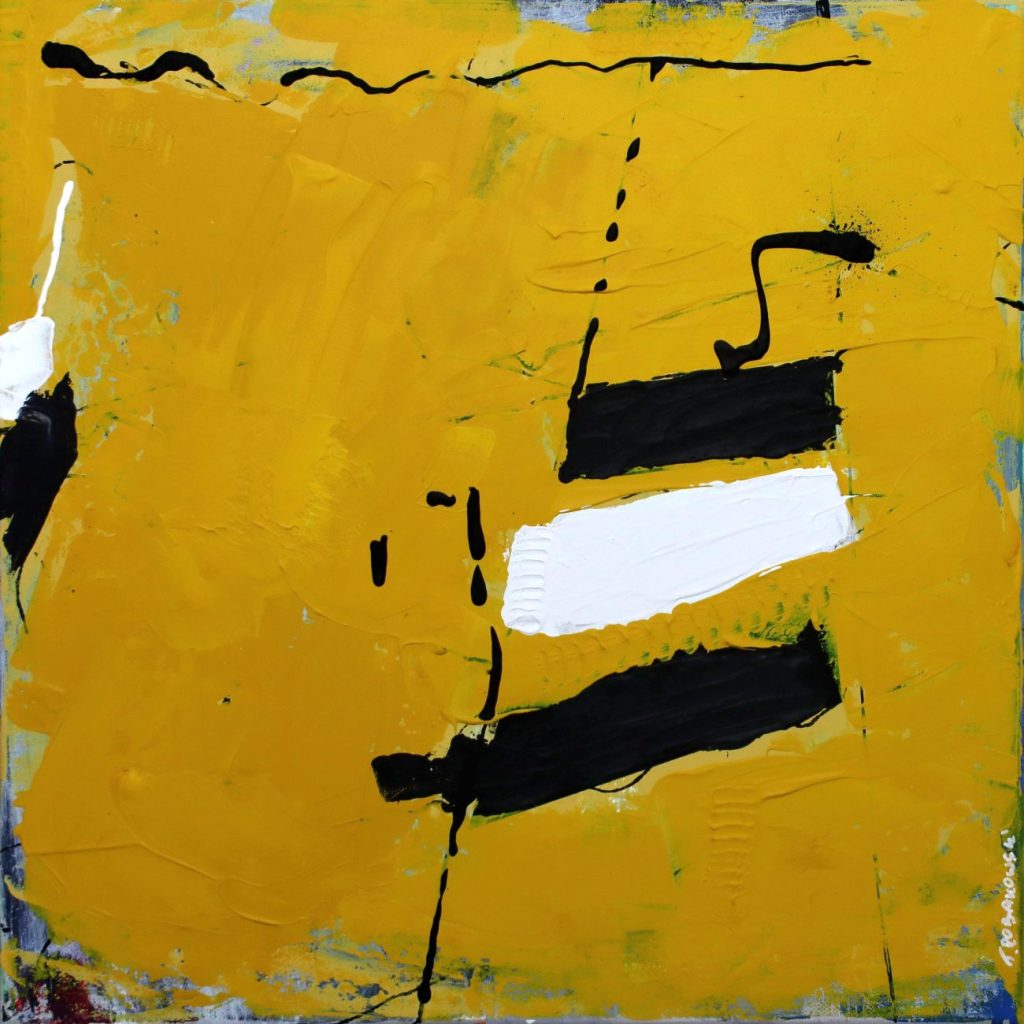
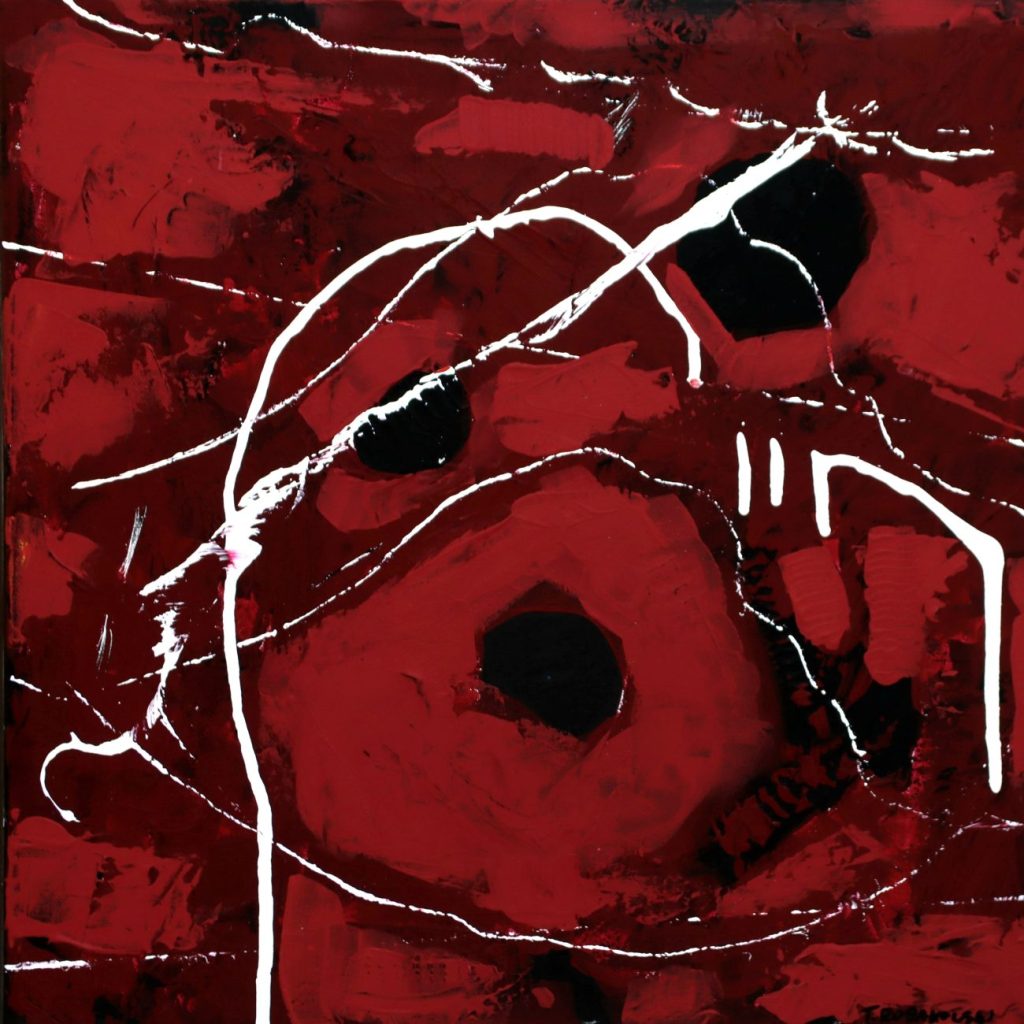
Robakowski’s practice explores the space between accident and control. He begins with impulsive marks or stains and builds from there, letting form and meaning emerge slowly. His “Cloud Atlas” series turns these abstract gestures into layered, narrative-rich compositions, where the eye moves across fields of color, form, and coded line. In the “Aftersects” series, he looks to the insect world for inspiration, using expressive textures and vibrant color to transform tiny natural forms into something mythic, strange, and oversized. Across these bodies of work, his materials—acrylic, relief pastes, markers, and pencils—are used to push and pull the image between abstraction and figuration.
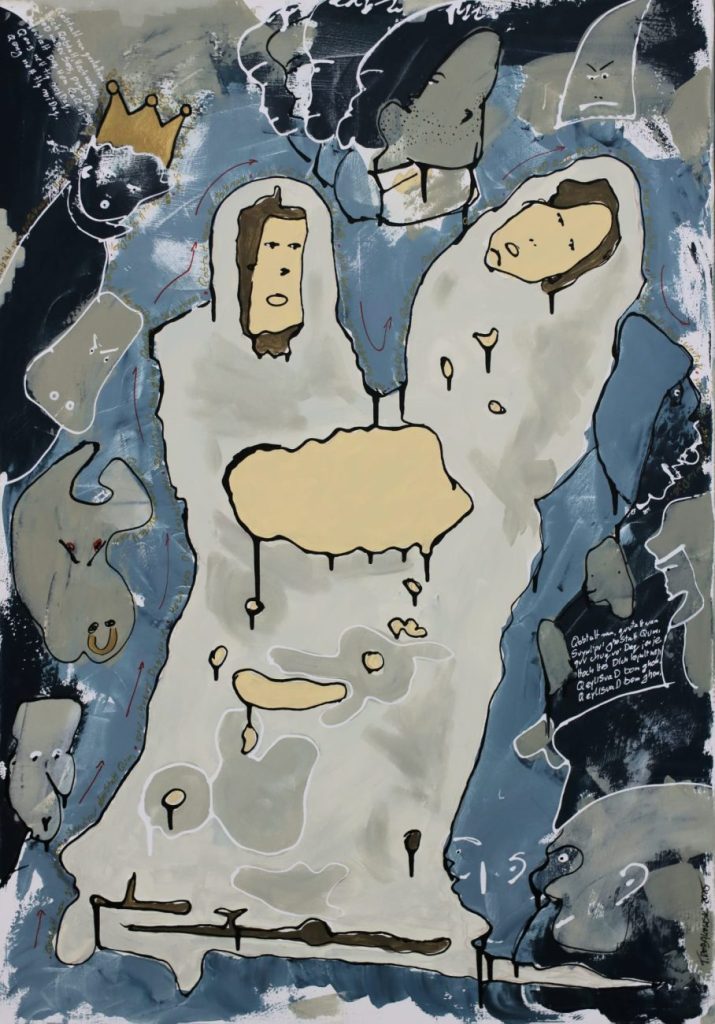
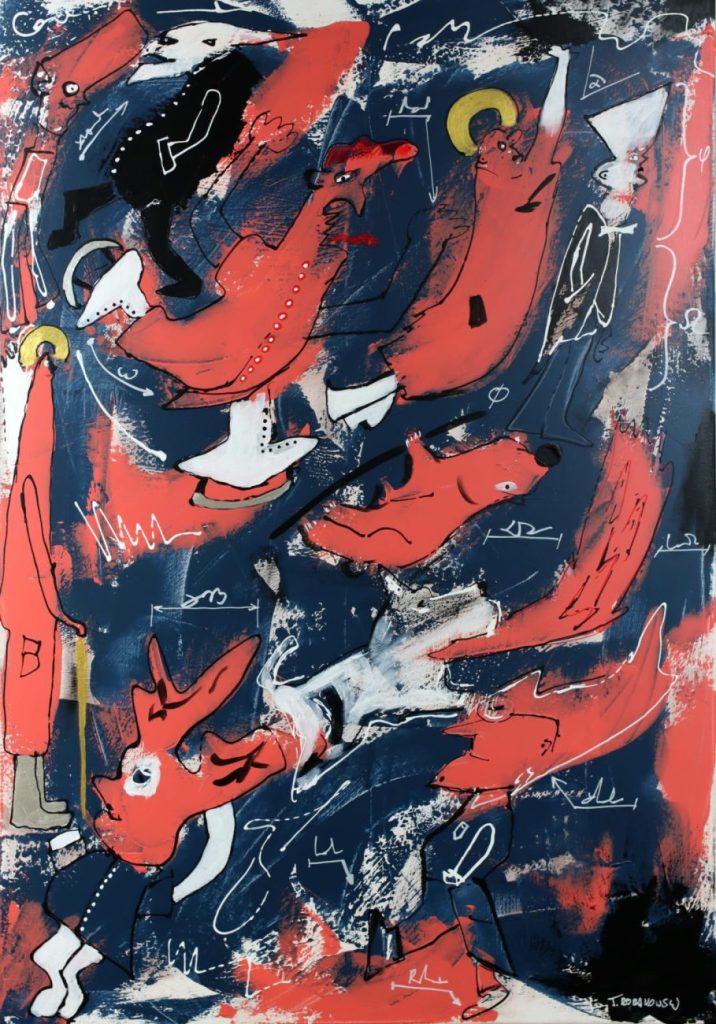
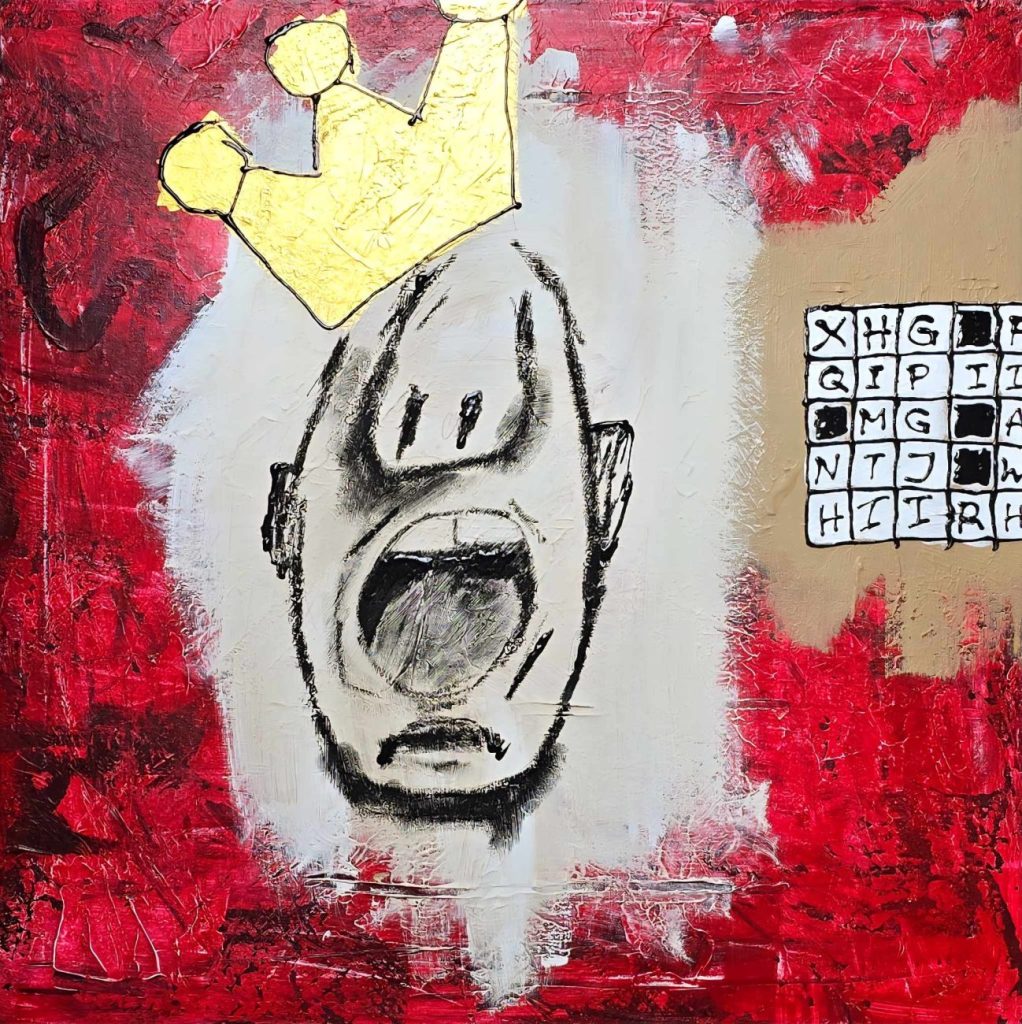
In “Something is Brewing,” one of the standout works from the Cloud Atlas series, a chaotic parade of red, white, and black figures hurtles across a dense blue background. Some are vaguely human, others animal, or cartoon, or something else entirely. Arrows, halos, and jagged outlines give the work the feel of a visual diagram, though one whose logic is deliberately unstable. The painting bristles with motion and layered marks, recalling the energy of artists like Jean-Michel Basquiat or Philip Guston, while still speaking with its own voice. “Face is the Key” strips things back. A rough portrait screams from the center of the canvas, its mouth agape beneath a jagged gold crown. Nearby, a crossword-style block of letters suggests coded language or hidden meaning. The mood is urgent, direct, and unresolved.
What makes Robakowski’s work compelling is not just its visual impact, but the way it creates space for the viewer to participate. These are not closed images, they are open systems, meant to be read and re-read. There is a subtle intelligence at play, one that favors curiosity over clarity, and emotion over polish. In a visual culture saturated with certainty and speed, Robakowski offers a slower, more layered way of seeing. His paintings ask us to look again, and to stay a little longer.