


"I'm always striving to do better, mastering my anatomical knowledge and seeking to create works of art that resonate with me and others through their emotional meaning in relation to my life and the world around me."
Read a Q&A with Patrick Masson
Talk to us about your work featured here.
What are the main themes and ideas explored?
What are the main themes and ideas explored?
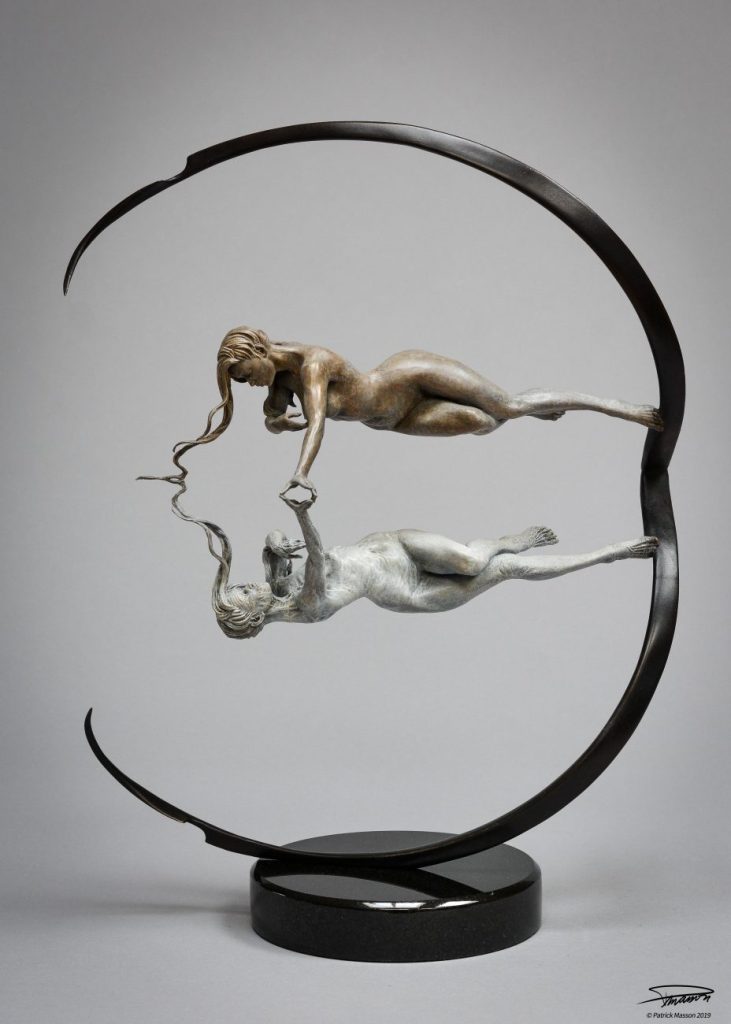
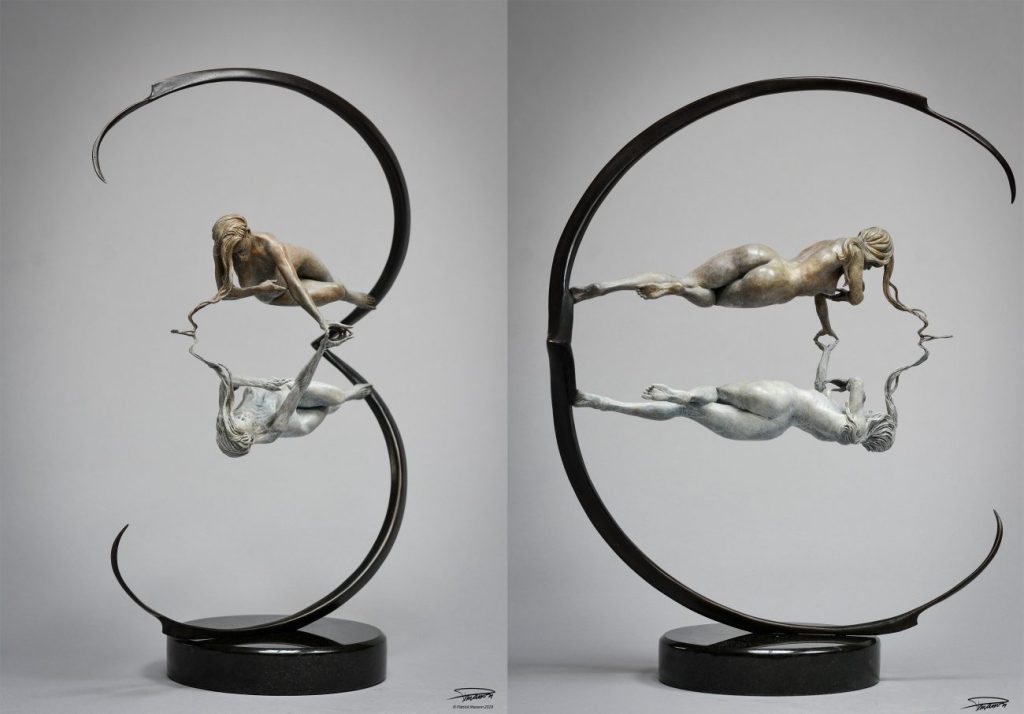
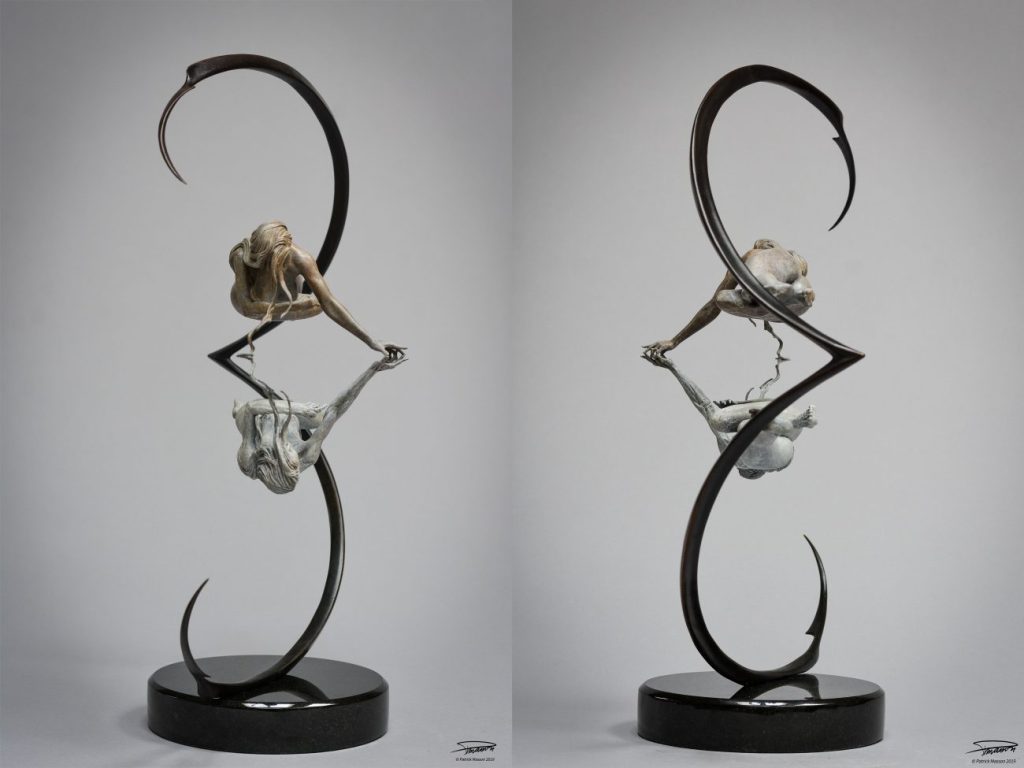
"Reflection" grapples with the idea of aging. In this piece, a woman stares at a two-way reflection that peers both forward and backwards in time.
The young woman looks at herself at an advanced age, weeping as she sees her beauty and her life disappearing, and in turn, the old woman smiles at her younger version because she knows how beautiful life has been, how much it was worth living, and that each stage was worthwhile. By creating this dialogue between the aging and the aged, specifically with the conclusive smile, I tend to exorcise my fear of growing old as I further grapples with death. This piece reassures myself about this coming.
The young woman looks at herself at an advanced age, weeping as she sees her beauty and her life disappearing, and in turn, the old woman smiles at her younger version because she knows how beautiful life has been, how much it was worth living, and that each stage was worthwhile. By creating this dialogue between the aging and the aged, specifically with the conclusive smile, I tend to exorcise my fear of growing old as I further grapples with death. This piece reassures myself about this coming.
Describe your creative process.
In general, everything starts with an idea for a movement or a pose. From there, I start to sketch out a framework for it and build the main volumes with clay (polymer clay when the sculptures are small-scale, oil-based clay when they are larger). This is often a phase when things can change shape and even ideas. Indeed, as I generally don't have a very clear image of my creation from the outset (when it's a personal project), the idea evolves and changes as I sculpt and becomes more and more precise as the sculpting work progresses.
When it becomes clearer the sculpture can be refined and it takes hours, days, months. I can be focused on specific points for very long time. It is always difficult to decide when a piece is finished as I'm never fully satisfied.
When it becomes clearer the sculpture can be refined and it takes hours, days, months. I can be focused on specific points for very long time. It is always difficult to decide when a piece is finished as I'm never fully satisfied.
What are the main influences and inspirations behind your art?
My main source of inspirations are the human and animal body. Seeing all the beauty in the shapes created by the bodies in motion inspires me to create my visions of the anatomy.
I'm highly inspired by the work of Bernini and the old masters. Their mastery of the human forms and expressions are what I am looking for in my journey into sculpture.
Contemporary artists like Brian Booth Craig, Coderch & Malavia and many more are also big sources of inspirations and influences.
I'm highly inspired by the work of Bernini and the old masters. Their mastery of the human forms and expressions are what I am looking for in my journey into sculpture.
Contemporary artists like Brian Booth Craig, Coderch & Malavia and many more are also big sources of inspirations and influences.
What is unique about your art? What do you consider the strongest aspect of your work?
It's very difficult for me to answer this question because I consider myself a beginner in art and I'm not sure I've found my unique style yet. Perhaps I'd say it's the way I interpret my anatomical knowledge into a realistic sculpture with a certain elegance of form and movement that makes it believable and somehow alive.
The strongest aspect of my work is the precision of the anatomy, even if I still have a lot to learn and improve on this particular point. That's exactly why I love this aspect so much, it's an inexhaustible source of learning.
The strongest aspect of my work is the precision of the anatomy, even if I still have a lot to learn and improve on this particular point. That's exactly why I love this aspect so much, it's an inexhaustible source of learning.
What message or emotion do you hope viewers take away from experiencing your art?
What I love the most is when someone tells it evoques he/her something even then it is not my personal view of it. The fact they feel any emotion while looking at my work is the only thing that I wish, whatever they feel honestly.
What is the biggest challenge for an artist?
What is the hardest part of your job?
What is the hardest part of your job?
The most difficult thing for me is not to lose the love and desire to create. Sometimes external events (personal, world events) can have a very bad influence on my creativity. Creating beautiful things when I'm in a bad mood is a difficult time for me. Finally, my perfectionism is sometimes my worst enemy when it comes to creating, because I'm afraid to start because I know that the road to creating my art will be long and difficult and it can froze my work.
What is the most rewarding part of being an artist?
When someone you don't know at all feels an emotion when they look at my work, that's the most gratifying thing for me.
How do you balance tradition and innovation in your work?
I like to continue to use the traditional method as much as possible, although I try to use the technology available to us, such as digital sculpture, where it can bring something valuable to the creation of the work. For example, helping with the design and iteration on the support, ensuring that the form will support the sculpture as was the case when creating the work Reflection.
But for me, new technology should not replace what makes human art unique, the manual work and the emotion that comes naturally from the relationship with the material when the work is created, and nothing will replace that in my eyes.
But for me, new technology should not replace what makes human art unique, the manual work and the emotion that comes naturally from the relationship with the material when the work is created, and nothing will replace that in my eyes.
What does "good art" mean to you?
What makes a piece of art great?
What makes a piece of art great?
The emotion that comes from it. When you can't stop looking at a piece because of the emotion it brings you in. For me it is often linked to a mastery of technical aptitude but transcended to an emotional purpose.
What is the role of the artist today?
The role of an artist today is still the same at it has always been in my eyes, bringing beautiful into this world to interpret and restitute the beauty of the world so that there is a trace of emotion fixed in time that people can enjoy know and for eternity.
See More Art by Patrick Masson
This interview was published by Circle Foundation for the Arts © CFA Press ∙ Images are courtesy of the artist