
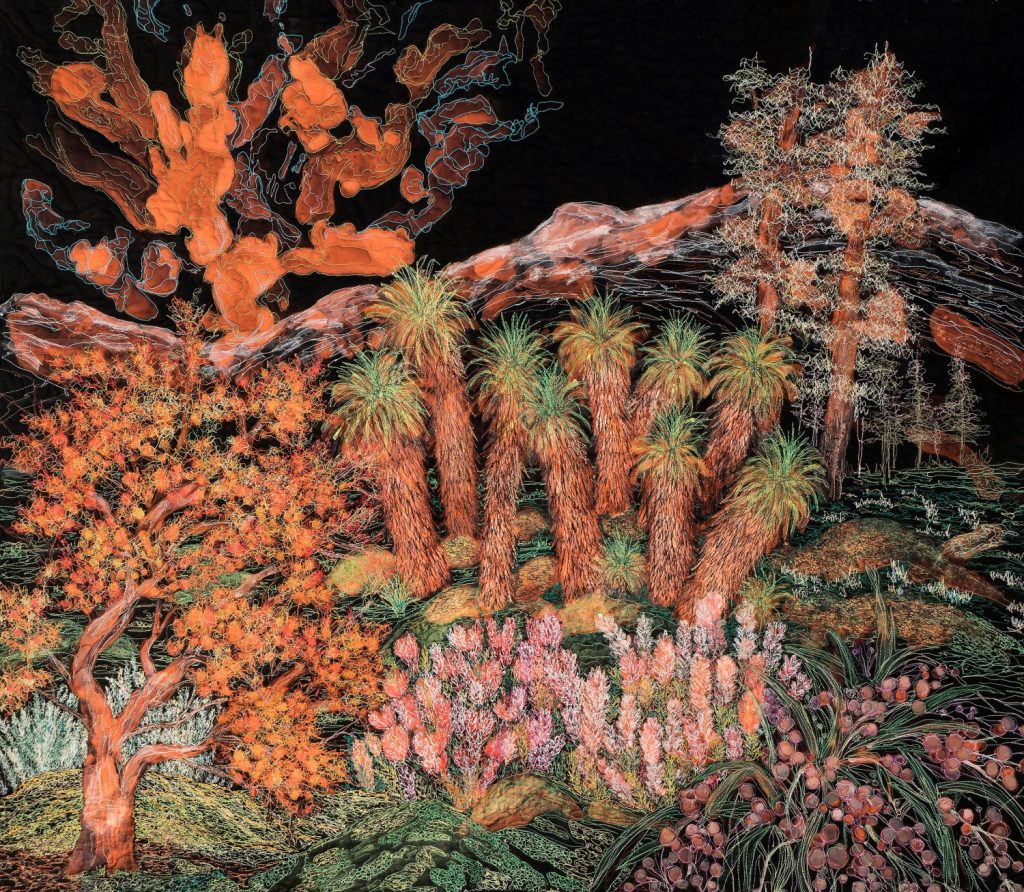
What on Earth Bleach, acrylic, and shellac ink painting, free motion machine drawing 99 x 110 cm
Inquire
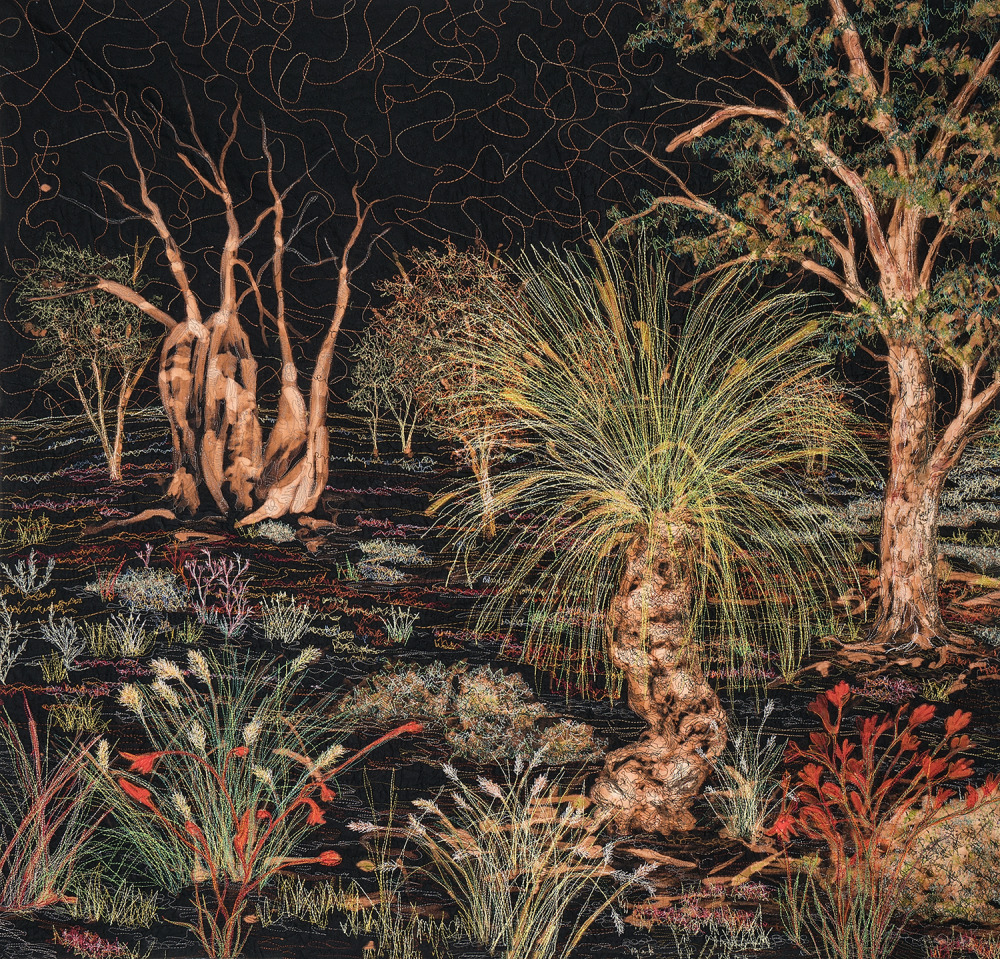
Out There - Bleach painting, free motion machine stitching, fabric, batting, thread, shellac ink, 90 x 90 cm (NFS)
Inquire
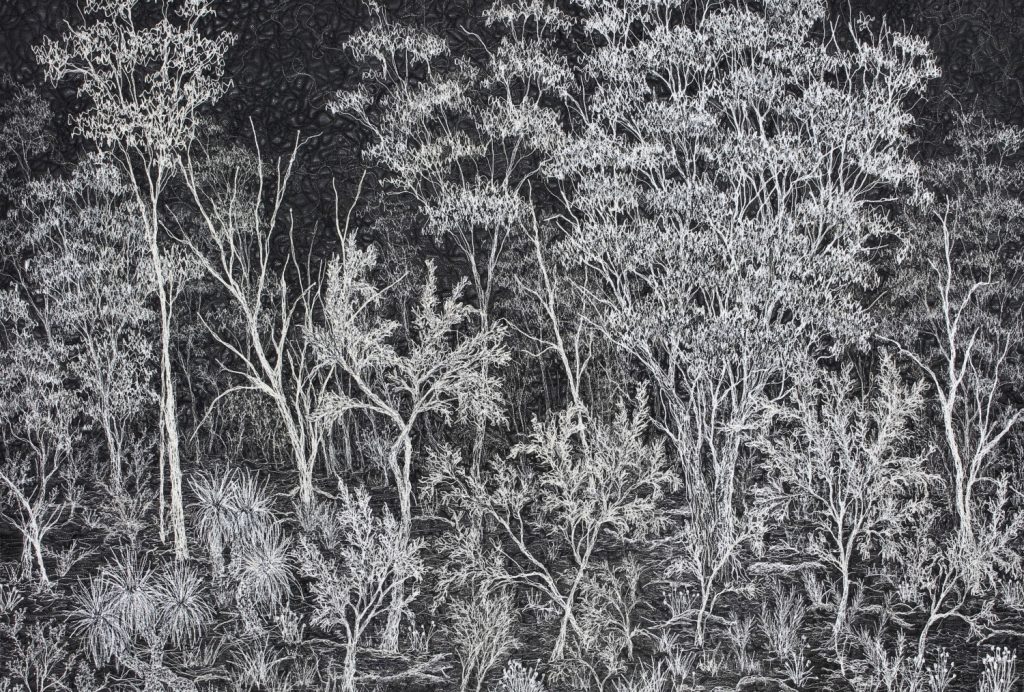


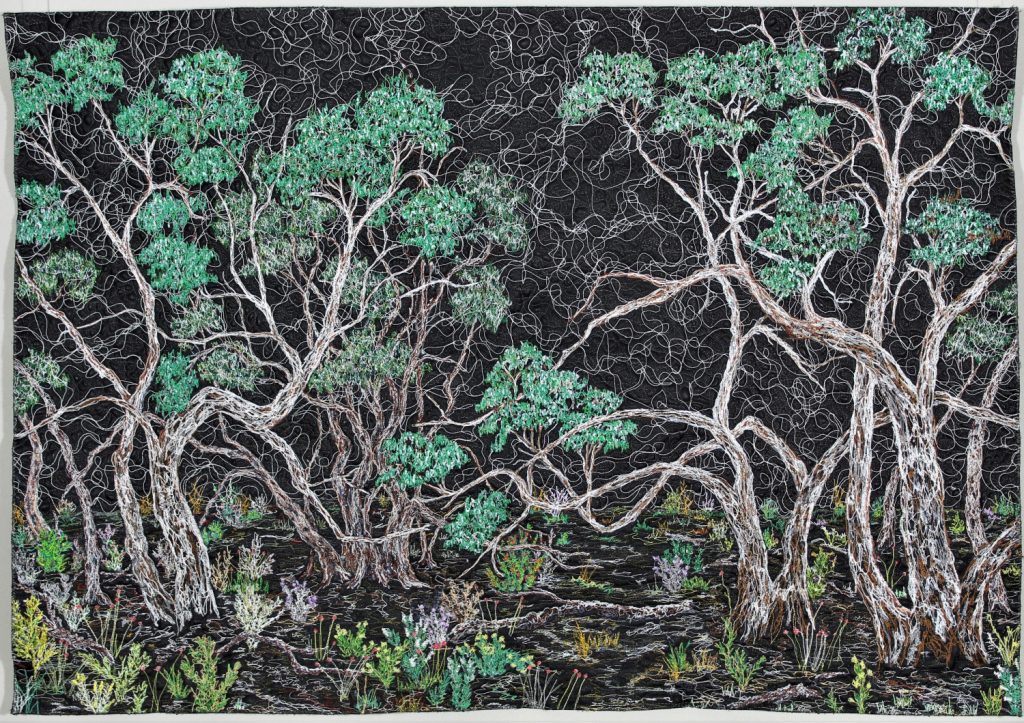
Moonahs at Midnight Free motion machine and acrylic marker drawing on black primed canvas 63 x 89 cm

Inquire
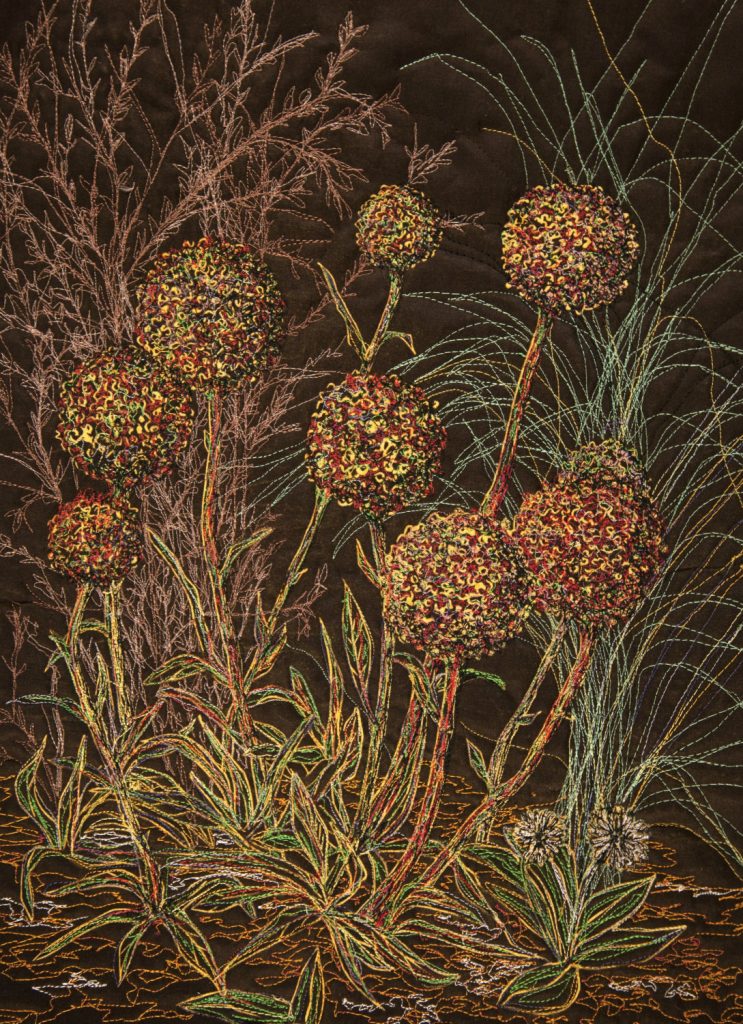
Before the Snow Free motion machine drawing on unique state linocut printed on fabric 41 x 30 cm

Inquire
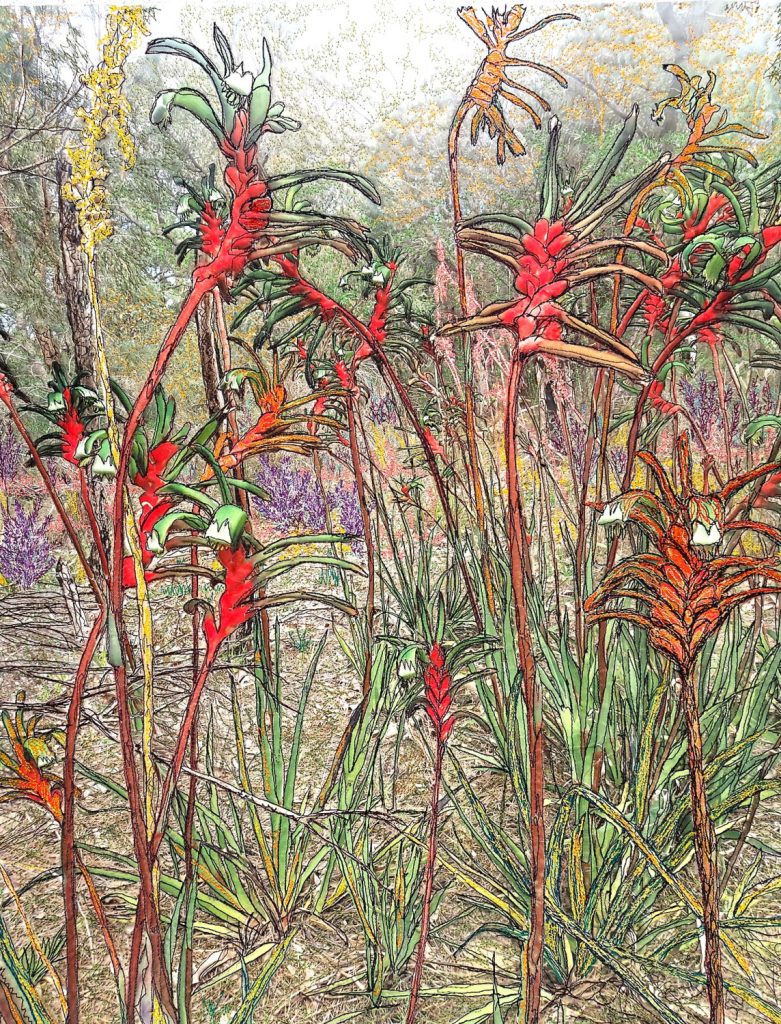
Bloom Embellished inkjet canvas photographic print with free motion machine and acrylic marker drawing 84 x 68 cm

Inquire
"My artistic practice is rooted in my profound connections with the natural environment. My work seeks to encapsulate and unveil the sense of wonderment, diversity, and beauty inherent in wild and remnant habitats. Extremely drawn to fragile and threatened landscapes, I am committed to imparting the value and significance of appreciating and safeguarding the remaining habitats of importance."
Read a Q&A with Irene Koroluk
Talk to us about your work featured here. What are the main themes and ideas you explore in it?
'What on Earth' aims to capture the beautiful and diverse flora and landscape of Mt Field National Park which is part of the Tasmanian Wilderness World Heritage Area. The work includes flowering scorparia, cushion plants, pencil pine and one of the few Australian deciduous trees called Fagus. I also wanted to capture the sublime moment I experienced my first Aurora Australis (Southern Lights).
Describe your creative process.
Before commencing any work, I attach canvas or fabric to an underneath layer of bag batting using free motion machine drawing in a repeated pattern. This repetition allows me to get into the right creative head space. Once complete, my first starting point is always a tree or a plant. From there I add more and more foliage, working from foreground to background. My work is improvisational, with no outlines or sketches. As I often work blind due to scrunching up my work to fit it in between the sewing machine arm and bed, a lot of time is taken balancing and rebalancing the design. I know a work is finished when I stop wanting to add or unpick content.
What are the main influences and inspirations behind your art?
My work is influenced by the materials and the facilities I have available when I start a piece. Upholstery thread colours, and bag batting I require are not always available, so I need to work within those confines. Content wise, my work is inspired and influenced by my encounters with the natural world; places I explore and travel to. My work is also informed by my academic art and environmental background, interest in conservation, and my residence which borders a ravine with towering eucalypts. Textile and mixed media artists who have inspired me include Ghada Amer, Sterling Ruby, Michael Raedecker and Alice Kettle. I've also always had an inner compulsion to scribble.
What do you consider the strongest aspect of your work?
There are very few artists that combine free motion machine drawing with black or white primed canvas. The strongest aspect of my work is my mastery of drawing with thread.
What message or emotion do you hope viewers take away from experiencing your art?
My aim is for audiences to:
•be immersed, captivated and slowed down by detailed and layered interpretations of nature's: minutiae, intricate details, colours, shapes and patterns;
•be inspired to step out and experience these enchanting, diverse and beautiful environments for themselves; places that renew the soul and allow us to simultaneously find and lose ourselves;
•reflect on the importance and value of appreciating and protecting habitats of significance;
•be introduced to the environmental challenges of our times in a way that is tactile, accessible and engaging.
•be immersed, captivated and slowed down by detailed and layered interpretations of nature's: minutiae, intricate details, colours, shapes and patterns;
•be inspired to step out and experience these enchanting, diverse and beautiful environments for themselves; places that renew the soul and allow us to simultaneously find and lose ourselves;
•reflect on the importance and value of appreciating and protecting habitats of significance;
•be introduced to the environmental challenges of our times in a way that is tactile, accessible and engaging.
What is the biggest challenge for an artist? What is the hardest part of this job?
The biggest challenge for many artists is earning enough to make a living. My biggest challenge is back, knee and elbow pain from having to sit for extended periods.
What is the most rewarding part of being an artist?
For me the most rewarding part of being an artist is the huge buzz and validation I get from selling and having people admire my work, getting into art prizes and being published.
How do you balance tradition and innovation in your practice?
I have begun making a new series of sculptural organic shaped works from multiple small quilts. They are a contemporary take on art quilts and show new possibilities of working with the medium.
What does "good art" mean to you? What makes a piece of art great?
Good art to me is work that makes me go 'wow'. It often uses techniques or materials I have not come across, or made by someone whose mastery of technique and workmanship is out of the ordinary. It is work that makes me want to ask questions including how on earth did they do that? It is work that I want to marvel at, spend time with, and stirs my soul. Good art to me is often unique with unusual or difficult content. Good art can evoke emotions of discomfort, happiness, and admiration of beauty. Great art is art that you see and never forget, it is art that speaks to you. Louise Bourgeois's spiders, William Rickett’s Aboriginal sculptures, Rew Hanks's lino cuts to name a few. It is work on your bucket list that you want to see before you die; and when you see it, it makes you more whole.
What is the role of the artist today?
Being an artist allows me to share my love of the natural world and hopefully inspire people to go out and be enriched by it. It allows me to continually learn and improve, expand my imagination and keep my brain healthy. Art chose me through luck, being able to draw, and being in the right places at the right times. Art in contemporary society should have many roles including: community engagement and inclusion through community-based art; cultural, aesthetic and individual enrichment; and social and political education and activism.