Theodore Robinson (1852–1896) was a pioneer of American Impressionism and one of the earliest American artists to closely engage with the French movement at its source. Born in Vermont and trained at the National Academy of Design in New York and later at the École des Beaux-Arts in Paris, Robinson was steeped in the academic tradition before he encountered the revolutionary aesthetics of the Impressionists. It was in the village of Giverny, near Claude Monet’s home, that Robinson’s mature style blossomed.
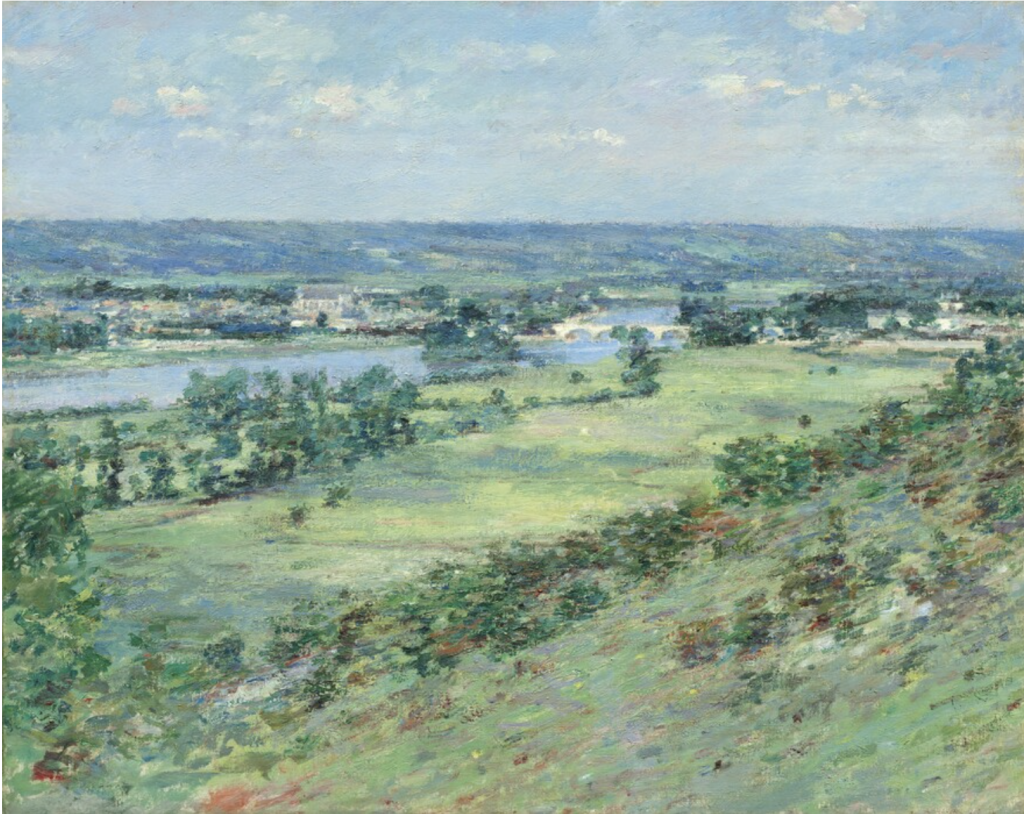
Between 1887 and 1892, Robinson spent significant time in Giverny, developing a close friendship with Monet. Under Monet’s influence, Robinson abandoned his earlier tonalism in favor of brighter palettes, broken brushwork, and plein air techniques. Yet even as he adopted Impressionist methods, Robinson maintained a distinctly American sensibility. His compositions often emphasize calm, compositional order and atmospheric subtlety, qualities seen in works like “La Débâcle” (1892) or “The Wedding March” (1892).
Robinson’s best works capture fleeting moments of rural life and quiet domesticity, favoring bridges, gardens, hayfields, and women in repose. There’s a lyrical, introspective quality to his paintings—less exuberant than Monet’s but no less attentive to light and mood. Unlike many contemporaries who imitated the French style superficially, Robinson internalized Impressionism, filtering it through a poetic and measured gaze.
Though his career was cut short by illness—he died at only 43—Robinson left a significant legacy. He returned to the U.S. in the early 1890s, bringing with him a refined and authentic approach to Impressionism. His influence helped shape the development of the style in America, particularly among East Coast painters and students of the burgeoning American art schools.
Robinson’s work reminds us that Impressionism was never monolithic. His art stands as a meditation on quiet beauty, translating the language of light into a distinctly personal dialect. Through his brush, the pastoral and the personal merge, giving American Impressionism a voice that is both reverent and uniquely its own.