

"I draw what moves me, believing that is reflected in my art. I have long championed colored pencils for their deeply saturated hues, ease of use, and portability. They allow me to create effects from fine lines to thick, burnished layers resembling oil paintings. Whether realistic or impressionistic, my art embodies a lifelong love for nature infused with a softness to show its intrinsic fragility."
Read a Q&A with Lynn Stephenson
Talk to us about your work featured here. What are the main themes and ideas you explore in it?
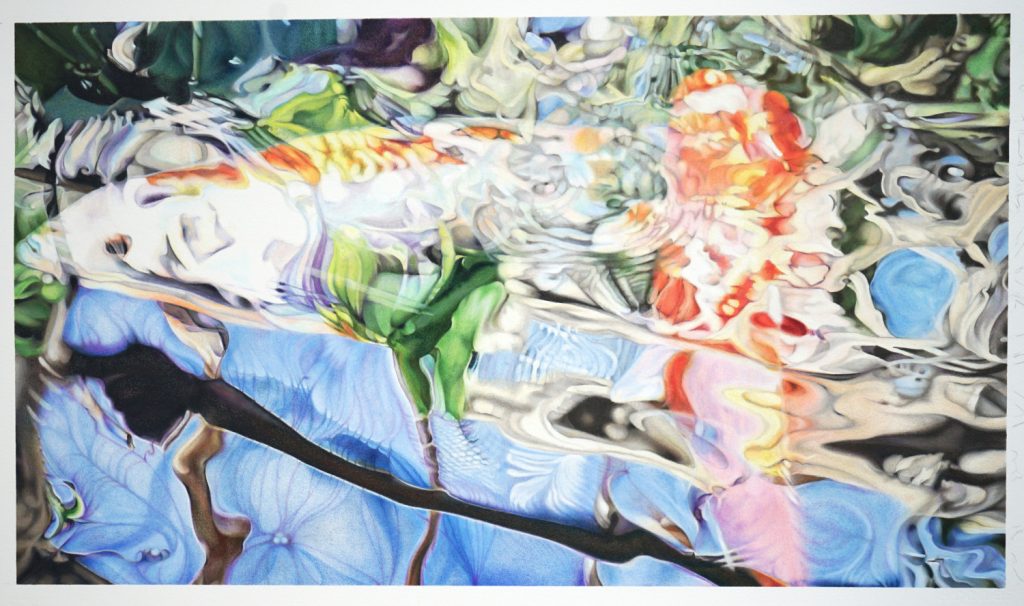
Koi Bokeh is my first impressionistic work. The theme is still straight from nature, but in a turn away from the in-focus world of realism, I chose to let the patterns and colors take center stage over the object itself. The result is a much more imaginative and expressive piece. I loved the freedom being untethered to reality brought, and plan to continue in this new direction.
Describe your creative process.
My pieces can take weeks to complete, so I dont work plein air, but from photographs I take in nature. I combine ideas from the pictures into preliminary sketches and once finalized, I transfer a tracing onto the final paper substrate. Usually Arches, Strathmore, Fabriano or Canson. I'll use anything lightly toothed that will accept a lot of pigment layers but also allow fine lines. It has to withstand erasing, burnishing and scratching without wearing through or buckling. I pick out the pencil colors I think I'll want and categorize by color families on my drafting table. I may use a hundred different colors in any one piece. I use pencils, erasers, blades and nothing else.
What are the main influences and inspirations behind your art?
Everything i draw comes from nature, Since moving to the shores of Lake Michigan I have but to look out the window to feel inspired, and awed by the view. My father was an artist and certainly my main influence. He is the one who got me drawing at a very early age. When I was introduced to colored pencils at Michigan's Penny W. Stamp School of Art & Design, that further influenced my direction. As far as artists go, Georgia O'Keeffe's use of form and color, anything of Monet that includes his beautiful depictions of water, and also the use of pattern by Gustav Klimt.
What do you consider the strongest aspect of your work?
I think my technical skill level with colored pencil is very high, and that helps set me apart. Whether doing realism or impressionism, I embue a slight softness to my subjects to reflect the fagility of nature, which is a unique look. I believe my eye for patterns and movement, good composition, and strong use of color are definite strengths.
What message or emotion do you hope viewers take away from experiencing your art?
I want viewers to feel an elation, a lifting of spirits. I want someone to feel like they could look at the piece every day and there will always be something else to see, something they hadn't noticed before. I want the light to fill them with warmth.
What is the biggest challenge for an artist? What is the hardest part of this job?
Just being an artist is a huge challenge. Few can make money doing it. Even fewer make actually make a living at it. When you do create, getting your art in front of people is the next challenge. You can't hope to go viral on line. Only a small percentage get into galleries. Many really good artists create just for the sake of creating, and never make it in to the market at all. Artists are the only group of professionals i can think of that are never thought to actually work., They are also the only profession I know that has to give up 40-50% of their income to sell their product. It's all hard. It's all a challenge.
What is the most rewarding part of being an artist?
It is so amazing when the creativity just flows and a blank piece of paper turns into something as if by magic. There are times that hours blur and seem to pass in an instant. Decisions are made over and over without conscious thought and something appears out of nothing. I love th0se times when you are absolutely lost in your art.
How do you balance tradition and innovation in your practice?
Up until last year I was very much in the tradtional realm. I worked in a very realistic style. But I wanted more. I needed to use my imagination and stretch my wings. I started on an Impressionistic journey and discovered an entirely new level to my work. I needed that change to keep me from getting stale. I feel renewed.
What does "good art" mean to you? What makes a piece of art great?
If an artwork has the basics of good composition and the artist has a mastery of the medium used, it has the possibility of being good. If it is also interesting in some way that makes it stand out from others, that helps. I cannot, however, define what it takes for art to be great. Some artists considered great were not sucessful during their lifetimes. Some artists successful during their lifetimes may not possess any more talent than other unknown artists, bringing luck and timing into the equation. I think greatness is pretty elusive.
What is the role of the artist today?
Artists today have varied roles. They can create a visual history of what is going on in the world. They can draw attention to causes that need exposure. They can communicate complex ideas or emotions and offer perspectives on social, political or cultural issues. The can make people reflect on the world around them. Art has the power to inspire action and advocate change. But sometimes, I think our role can to simply create beauty and bring joy.