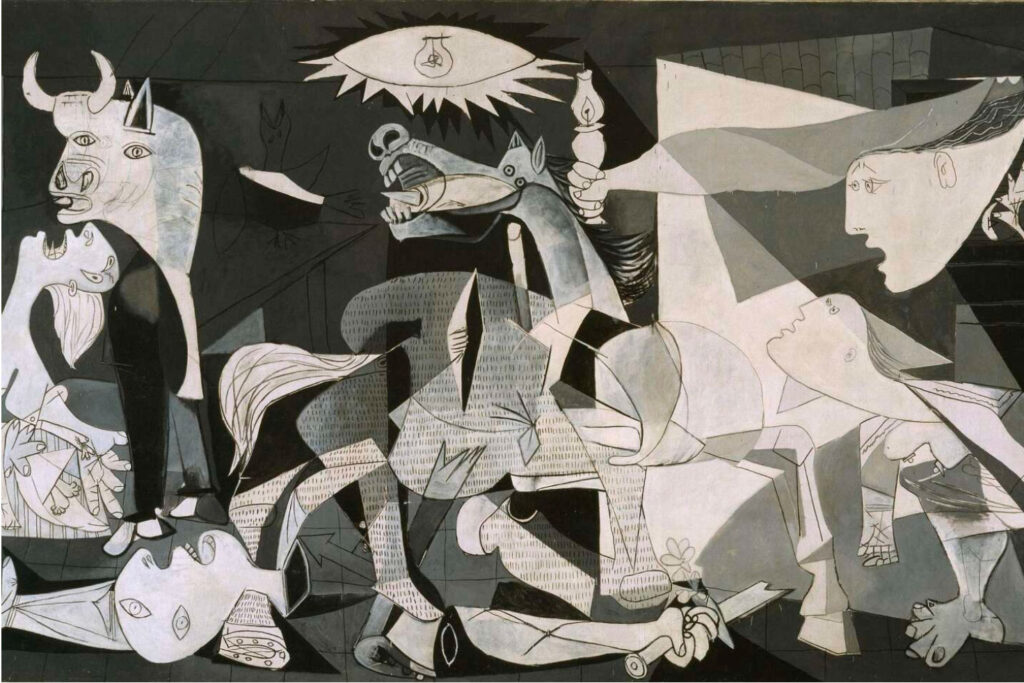
‘Guernica’ is among Pablo Picasso’s most iconic and influential works, created in 1937 as a direct response to the bombing of the Basque town of Guernica during the Spanish Civil War. Commissioned for the Spanish Pavilion at the Paris World’s Fair that same year, the painting stands as a visceral and haunting depiction of the horrors of war. Through its nightmarish imagery and distorted figures, ‘Guernica’ captures the suffering, chaos, and inhumanity inflicted upon innocent civilians in times of conflict.
From an art historical perspective, ‘Guernica’ is remarkable not only for its scale—measuring over 3.5 meters tall and 7.8 meters wide—but also for its stylistic innovation. Drawing on elements of Cubism and Surrealism, Picasso deploys a fractured, abstract visual language to convey disorientation and pain. The monochromatic palette of black, white, and gray heightens the emotional gravity of the scene, stripping away distraction and color to confront viewers with stark, symbolic imagery. The use of fragmented forms and overlapping planes reflects the shattering impact of war on both people and place.
Politically, the work functions as a powerful condemnation of violence and authoritarianism. Picasso intended the painting as a direct response to the aerial bombing carried out by German and Italian forces on behalf of Franco’s regime, and more broadly, as a protest against the brutalities of fascism. ‘Guernica’ quickly became a symbol of resistance, not only within the context of the Spanish Civil War but throughout the 20th century, resonating with movements against oppression and injustice worldwide.
Socially, ‘Guernica’ ignited immediate controversy and discussion upon its unveiling. Some viewers praised its emotional intensity and moral urgency, while others were unsettled by its abstraction and lack of traditional realism. Yet despite this initial division, the painting soon captured the public imagination. Its raw, uncompromising vision of civilian suffering became emblematic of the broader tragedies of modern warfare.
‘Guernica’ remains a timeless and universally recognized symbol of peace, protest, and the enduring power of art to speak truth to power. Its relevance endures in a world still marked by violence and unrest. As both an artwork and a political statement, it challenges viewers to reckon with the cost of war and to imagine the possibility of a more just and compassionate world. Picasso’s masterpiece continues to inspire artists, activists, and audiences alike—reminding us of the responsibility to bear witness and to resist.