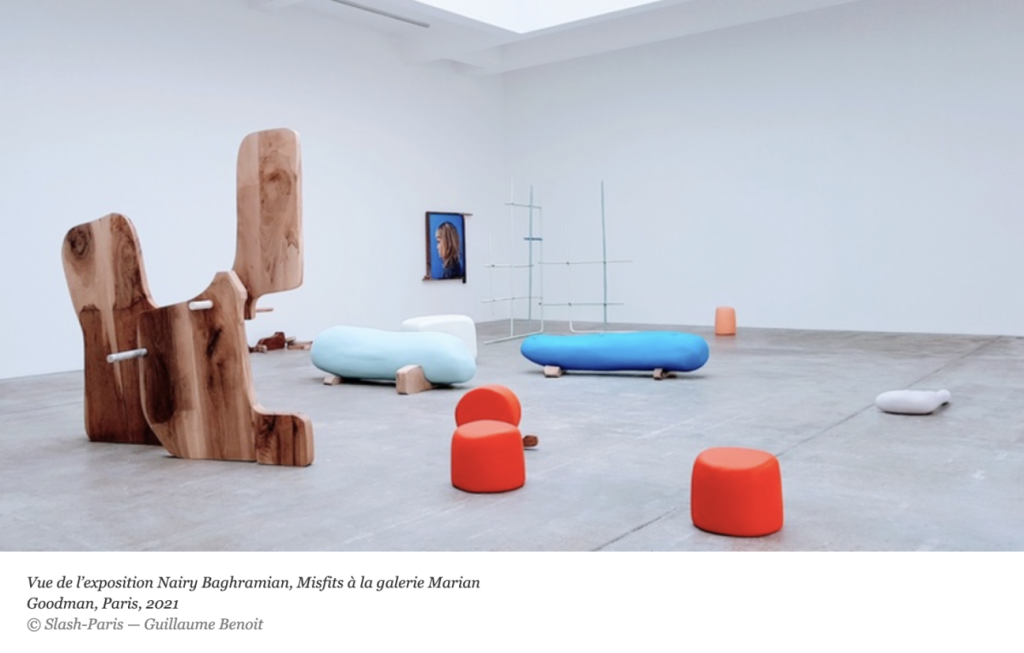
Nairy Baghramian: Sculpting the Body-Spaces in Flux
Born in 1971 in Isfahan, Iran, Nairy Baghramian moved to Berlin with her family in 1984, where she was raised and later educated at the Universität der Künste Berlin (en.wikipedia.org). Her formative years—imbued with displacement and cultural hybridity—shaped a sensitivity to identity and environment that remains central to her practice. Baghramian also engaged with film, dance, architecture, and theater, reflecting her multidisciplinary approach .
Over the past two decades, Baghramian has established herself as a leading voice in contemporary sculpture and installation. Her work frequently references Minimalism, Surrealism, and the architectural forms of interior design, while consistently drawing parallels to the human body. Using materials like steel, resin, silicone, marble, aluminum, wood, and wax, her pieces—abstract yet evocative—suggest joints, membranes, and fragmented limbs . A key series, Misfits, plays on the idea of functional but mismatched forms, creating compositions that feel at once bodily and mechanical .
Baghramian’s work is deeply attentive to context. Whether siteing sculptures in institutional galleries or public landscapes (like Knee and Elbow at Clark Art Institute), she continuously engages with the interplay between self, body, and space (news.artnet.com). Her work encourages viewers to question the fragility of structure and embodiment, often invoking paused or resting postures that foreground vulnerability in the face of form and scale .
Critics highlight her deft balance of material precision and conceptual openness, which opens sculpture to new modes of reading—where form, surface, and friction become narrative elements . Baghramian’s sculptures challenge assumptions about autonomy and function while expanding the language of abstraction and the politics of presence in space .
Significance and Influence:
Baghramian’s international exhibitions—at institutions including documenta 14 (2017), the Nasher Sculpture Center (2022), the Met’s façade commission (2023), and the South London Gallery (2024)—have cemented her status as a major voice in contemporary sculpture (en.wikipedia.org). She was awarded the prestigious Nasher Prize in 2022, and has also been a finalist for the Hugo Boss Prize (frieze.com). Her work influences and dialogues with modernist sculpture while insisting on sculpture as a critical, bodily, and spatial practice. Through her thoughtful site-responsiveness and cross-disciplinary approach, Baghramian continues to shape how we understand the sculptural body in contemporary art.