The elusive street artist known as Banksy emerged from the underground graffiti scene in Bristol, England, in the early 1990s. His true identity remains unconfirmed, though speculation abounds. Widely believed to have been born in the mid-1970s, Banksy grew up in a politically aware and culturally rich environment. While there is no public record of formal art education, his early involvement with the Bristol underground movement—alongside musicians, anarchists, and graffiti writers—shaped his visual language and radical ethos. His anonymity has become not just a tactic of self-preservation but a core element of his mystique and artistic brand.
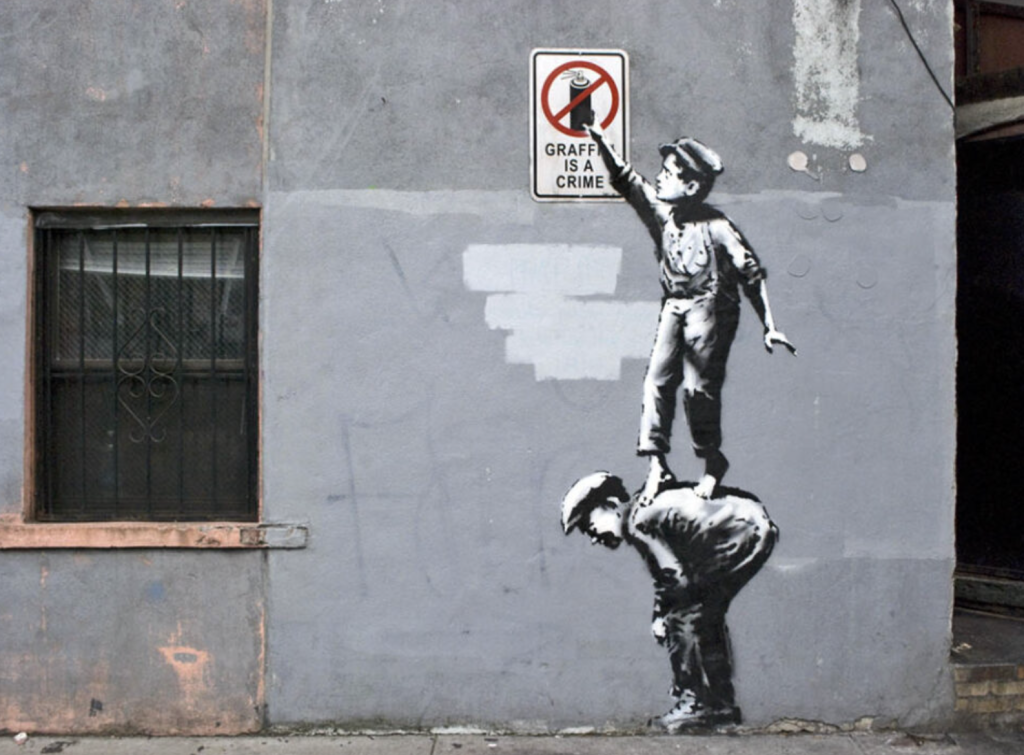
Banksy’s early works were raw, text-heavy graffiti pieces that carried anti-establishment messages, often painted illegally on city walls. Over time, his style evolved into a more polished and distinctive approach: politically charged stenciled images, often rendered in stark monochrome with occasional accents of red or pink. From his breakout pieces in London to international interventions in cities like New York, Bethlehem, and Paris, Banksy has built a body of work that remains both stylistically consistent and endlessly provocative. His more recent projects, including “Dismaland” (a dystopian theme park), “The Walled Off Hotel” in the West Bank, and surprise street pieces during the COVID-19 pandemic, show an artist who continues to experiment with scale, context, and medium—without abandoning his roots in street art.
At the heart of Banksy’s work lies a critique of power, inequality, war, surveillance, and consumer culture. His imagery is immediate and accessible, blending dark humor with biting social commentary. Works like Girl with a Balloon, Flower Thrower, and Napalm (featuring Mickey Mouse and Ronald McDonald holding hands with a scorched child) have become visual shorthand for anti-war and anti-capitalist sentiment. Banksy is a master of visual paradox—rendering harsh truths with striking simplicity. His interventions in public space often directly challenge institutions of art and governance, subverting expectations of where art belongs and whom it serves.
Banksy’s significance in contemporary art is undeniable. Despite his refusal to engage with the traditional art world through galleries or public appearances, his works have fetched millions at auction, and his critiques of capitalism are paradoxically sold within it. He has influenced an entire generation of street artists and continues to push boundaries regarding authorship, access, and authenticity. Banksy’s genius lies not just in his images, but in his strategy—reminding us that in an age of surveillance and spectacle, anonymity can be the most powerful statement of all.