
Mary Cassatt (1844–1926) was one of the most influential American painters of the 19th century and a vital figure in the Impressionist movement. Born in Allegheny City, Pennsylvania, Cassatt studied at the Pennsylvania Academy of the Fine Arts before moving permanently to France in 1874. It was in Paris that she came into contact with the leading avant-garde artists of her time, most notably Edgar Degas, whose friendship and critical support helped shape her early direction. Despite the social limitations imposed on women in the art world, Cassatt earned the rare distinction of exhibiting with the French Impressionists from 1879 onward.
Cassatt’s work centered on the domestic and social lives of women, rendered with a remarkable psychological sensitivity and formal boldness. Her favored subjects were mothers, children, and scenes of everyday life—composed with a modern eye for composition, cropped viewpoints, and an exquisite sense of pattern and color. Working in oil, pastel, and print, she developed a signature style defined by soft yet structured brushwork, luminous light, and a profound human intimacy.
What sets Cassatt apart is her capacity to merge formal innovation with emotional insight. Her pastel portraits of mothers and children—such as “The Child’s Bath” (1893) or “Young Mother Sewing” (1900)—are not sentimental but psychologically complex, portraying motherhood as both tender and absorbing. She was also a pioneer of printmaking, drawing inspiration from Japanese woodblock prints to develop color etchings that pushed the boundaries of her medium.
Mary Cassatt’s importance lies not only in her art but in her role as a transatlantic bridge between American collectors and French Impressionism. She advised patrons like the Havemeyers, whose acquisitions now form the core of the Metropolitan Museum’s Impressionist collection. In a movement dominated by men, Cassatt stood out for her quiet radicalism—bringing the world of women into the modernist frame with elegance, empathy, and intellectual rigor.
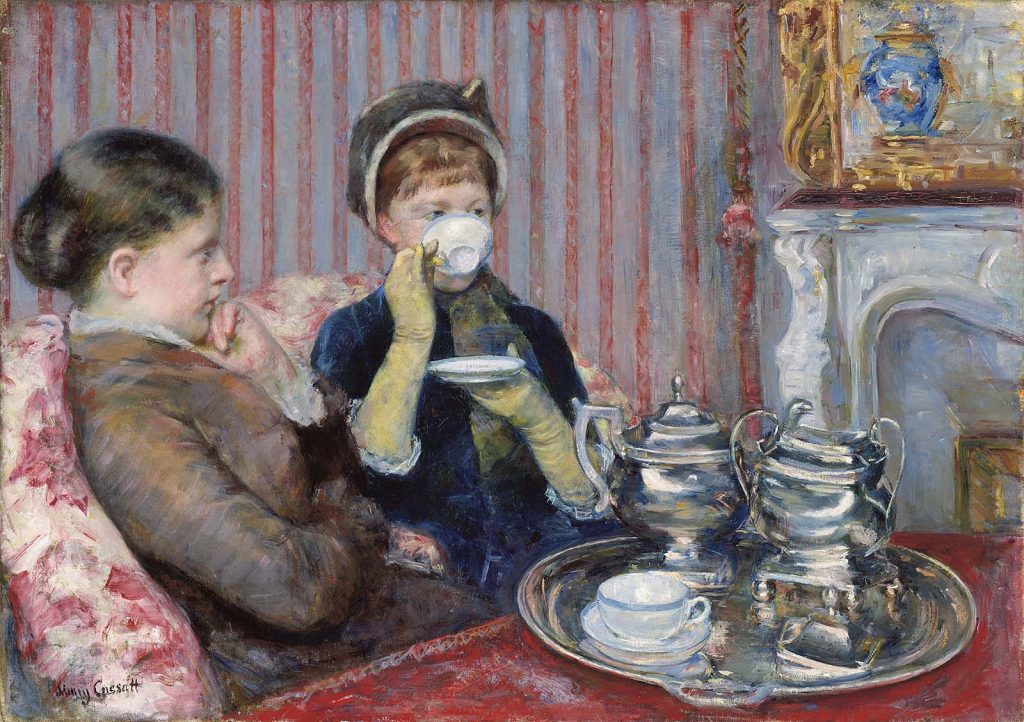
One of Mary Cassatt’s most celebrated early masterpieces, The Tea (c. 1880), is a pivotal work that marks her confident entry into the Impressionist movement while offering a layered critique of the societal roles assigned to women in her time. In the painting, two well-dressed women sit in a richly furnished parlor, one mid-sip of tea, the other with her face obscured by a dark hat. The setting is genteel, the palette refined, but something in the scene resists total ease. The women appear locked in quiet containment, surrounded by plush interiors that double as symbols of both comfort and confinement. With this work, Cassatt begins to explore the psychological and social undercurrents of the feminine interior world—territory she would make uniquely her own.
Cassatt’s composition is tightly structured, almost claustrophobic, with the furniture and décor pressing in on the sitters. The mirror in the background reflects the space yet offers no additional insight into the figures’ thoughts or emotions—only more ornamentation, more surface. The brushwork, while aligned with Impressionist practice in its looseness and light modulation, is tempered by a formal precision that speaks to her academic training. The colors are warm, muted, and domestic—ochres, reds, pinks, and browns—that subtly reinforce the atmosphere of polite restriction. Cassatt is not merely documenting a tea ritual; she is interrogating the performance of leisure and the weight of unspoken expectations within bourgeois femininity.
What makes The Tea so striking is its quiet subversion. Beneath the painting’s elegant façade lies a perceptive commentary on the isolation and surveillance embedded in women’s social spaces. The hat shielding one woman’s face can be read as a refusal of legibility, a moment of agency within a rigidly structured world. The tea table becomes both a point of communion and a barrier, and the silence between the women is as present as the objects around them. With The Tea, Cassatt achieves something remarkable: a modern painting that is visually lush, socially observant, and emotionally ambiguous. It is not a portrait of intimacy, but of distance—rendered with such grace and restraint that it becomes all the more powerful.