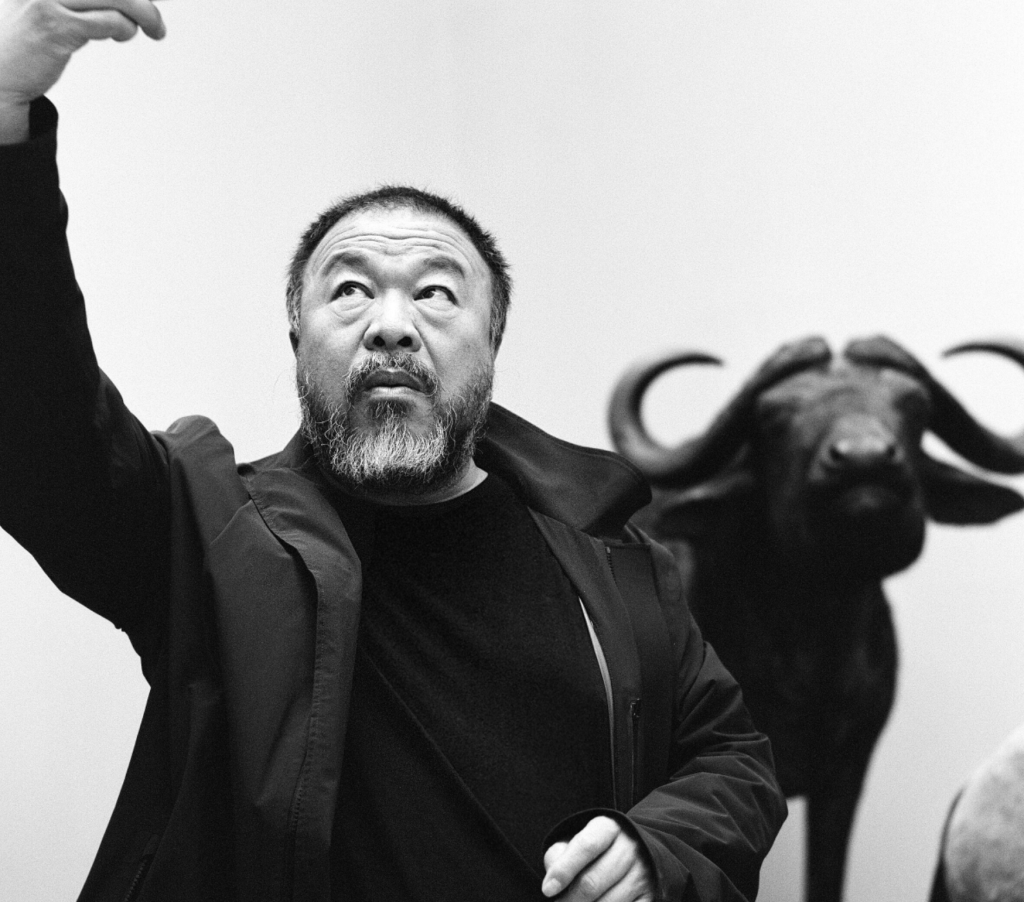
Born in 1957 in Beijing, Ai Weiwei is one of the most influential and uncompromising voices in contemporary art. The son of renowned poet Ai Qing—who was exiled during Mao Zedong’s Anti-Rightist Campaign—Ai Weiwei grew up under conditions of political suppression that would later inform the core of his practice. After studying at the Beijing Film Academy, he moved to the United States in 1981 and settled in New York, where he absorbed Western conceptual art, especially the work of Marcel Duchamp and Andy Warhol. These influences would later blend with traditional Chinese materials and motifs to form his distinct and politically resonant aesthetic.
Ai’s early work included photography and conceptual interventions, but he rose to international prominence in the 2000s with large-scale installations that interrogated state violence, censorship, and the commodification of culture. Pieces such as Dropping a Han Dynasty Urn and Sunflower Seeds (composed of millions of hand-painted porcelain seeds) exemplify his use of contradiction—destroying historical objects while revering their craftsmanship, multiplying individual gestures into monumental forms. His activism intensified after the 2008 Sichuan earthquake, when he publicly criticized the government’s negligence in the deaths of thousands of schoolchildren. This act led to surveillance, arrest, and eventual detention by Chinese authorities in 2011.
Ai Weiwei’s work blurs the line between art and protest. He uses sculpture, architecture, film, and social media to address issues of human rights, migration, freedom of expression, and the role of truth in the public sphere. Notable works include Remembering, a facade installation made from school backpacks commemorating the earthquake victims; Law of the Journey, an enormous inflatable refugee boat filled with faceless figures; and his documentary Human Flow, which charts the global migration crisis. His critique is never abstract—it is material, symbolic, and grounded in lived realities.
Ai Weiwei’s significance lies in his ability to harness the institutional power of contemporary art while fiercely resisting its tendency toward complacency. He is a dissident who works within the very systems he critiques, using global platforms to expose injustice and demand accountability. Few artists today have merged the political and the poetic with such force and clarity. Through his work, Ai insists that art is not a refuge from reality—but a tool for reshaping it.