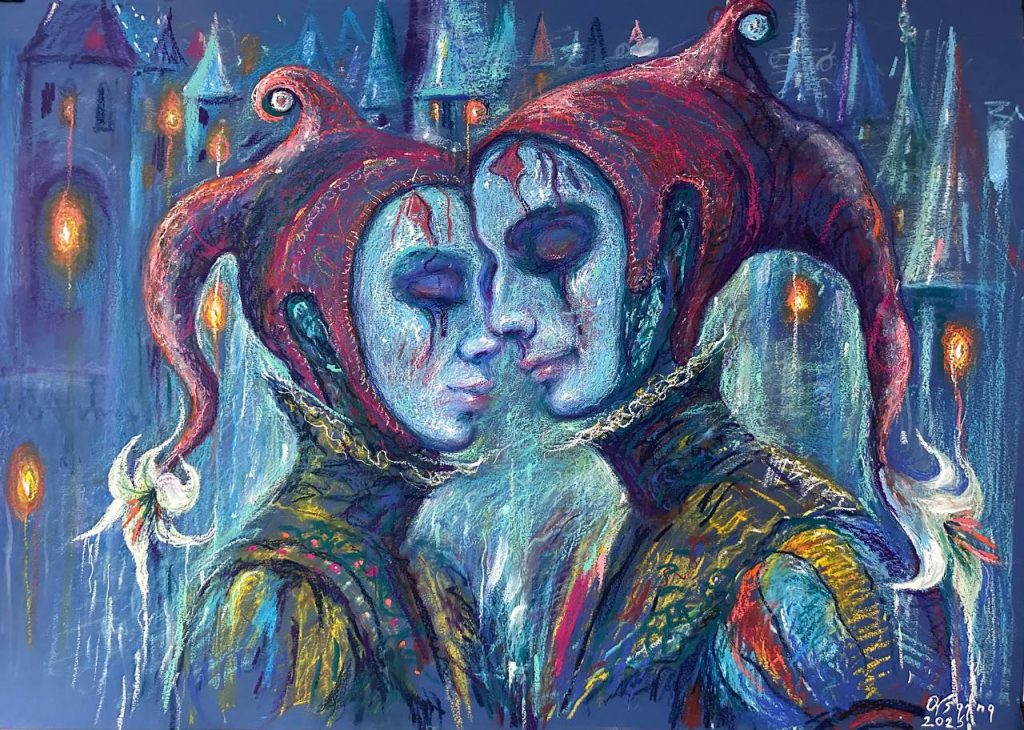
Harlequin. Light Behind the Mask
The collective image of Harlequin has long fascinated artists, poets, and philosophers. Perhaps this is due to the internal dissonance—between joy and sorrow, between lightness and something demonic—that stirs within the figure. It is precisely this contradiction that becomes fertile ground for the artist’s reflection, as every era rediscovers Harlequin anew, revealing different facets of the human condition.
For me, Harlequin is not merely a theatrical mask, but an archetype, a symbol of internal searching and fragmentation. In my recent series of works, he emerges as a natural continuation of the “Fauns” series, where the union of the earthly and the natural created a mysterious, almost mystical link. The Fauns represented instinct, rootedness, and the primal state of human nature before the split between spirit and flesh. Harlequin, however, is already a journey inward — into reflection, consciousness, into the fragile balance between appearance and essence.
The Mask as Protection and Vulnerability
Each time has its own Harlequin. During the Renaissance, he was a jester — witty and light-hearted. In the era of modernism — a figure on the edge of light and darkness, genius and madness. Today’s Harlequin is all of us. We all wear masks — not because we are false, but because we protect our fragile inner selves. The mask may be bright, even joyful, but behind it lies trembling sensitivity — a world that could fall apart with the slightest breath of wind, a mere touch of another’s gaze.
The colors in my works are deceptively bright — illuminated by night light, like neon illusions on a dark stage. In this night, each of us becomes a Harlequin hiding our emotions beneath a cloak, our thoughts behind geometric patterns, our intentions beneath an unchanging smile. Yet through the darkness, rare flashes of light break through. Fleeting, but sincere. These are what hold our inner worlds together, what prevent us from dissolving.
Symbolism and Form
In composing this series, I strive to avoid linear storytelling. My Harlequins exist beyond the stage — they appear in metaphysical space, stripped of scenery, where only the human form remains. A tilt of the head, a gesture, a slipping fabric — each element becomes a language. The color palette is deliberately contrasting: deep reds and blues clash with ghostly white. Not just for effect, but to express emotional amplitude — the tension and contradiction within the figure.
The mask plays a central role. It not only hides the face, but marks the boundary between the external and the internal. Through this mask, the viewer is invited to look inward — not into the Harlequin, but into themselves. That, perhaps, is the main effect: each viewer becomes a co-creator, trying on the mask, living through their own reflection in the image.
Connection to the “Fauns” Series
The Fauns were earthy, sensual, grounded. Their horns grew like roots — a metaphor for humankind’s ancient connection to nature. Harlequin is different. His horns are no longer part of the body, but part of the costume. This is a meaningful shift. We see a metamorphosis: from the organic to the symbolic, from the instinctual to the constructed. It is not a loss, but a transformation. The human being is no longer a part of nature but its reflection, its interpretation. Harlequin is the mask, the role — yet, like the Faun, he too seeks balance between the earthly and the spiritual.
On Fragility
The central theme of this series is fragility. I increasingly feel this as the essence of the modern human. We are surrounded by images of strength, confidence, and constant achievement, but in truth, we are delicate, sensitive, and vulnerable beings. My Harlequins express this fragility — in the folds of fabric, in the curve of a shoulder, in a barely visible tear, in the pause between movement and stillness. That trembling moment — it holds everything: the past, the present, and what is yet to come.
Art as a Space of Reinterpretation
I believe that art speaks of what cannot be said. Through Harlequin, I explore not an image, but a process. A process of becoming, of splitting, of release. Harlequin is not just a character, but a path. It may be tragic, but it is not devoid of light. His mask is not only protection, but a mirror — one in which we glimpse ourselves.
I am not seeking clarity or resolution. On the contrary, ambiguity is essential. Harlequin, like the Faun, becomes a portal — into memory, fears, dreams, past lives, and the longings we are afraid to name. It is an attempt to retain meaning in a world that changes too quickly.
Conclusion
This series is a personal confession — a quiet conversation with those who, like me, feel the world not only through the eyes, but through the heart. In the image of Harlequin, I see each of us. Behind the mask — a living soul. Behind the brightness — a longing to be seen. Behind the role — the true self.
I do not offer answers. I simply create a space where the question can be asked — and where the echo of that question might be heard.