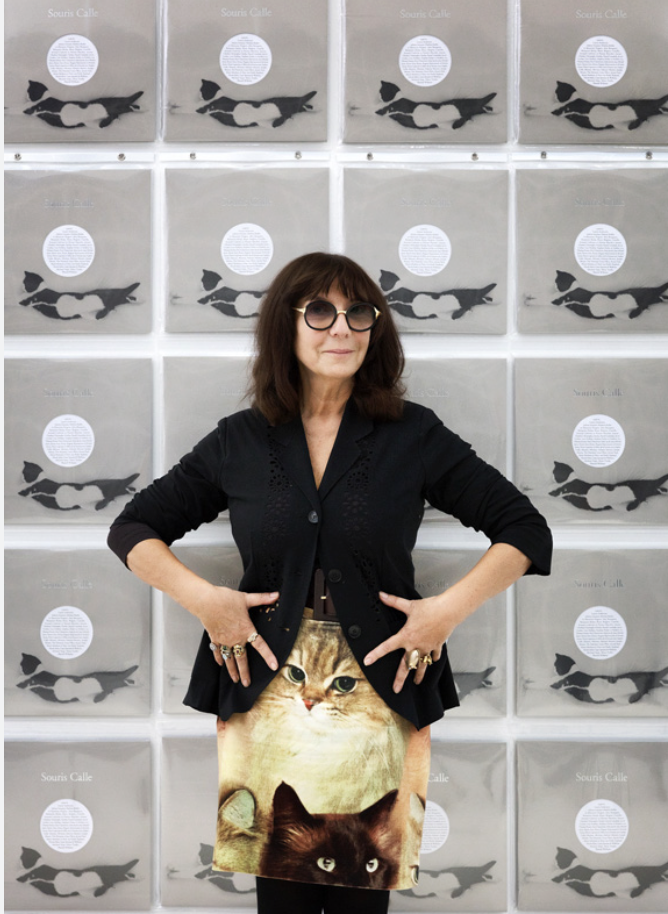
Sophie Calle is a French artist whose multidisciplinary work spans photography, installation, text, and performance. Born in Paris in 1953, she was raised in a cultured environment that exposed her early to the arts, literature, and philosophical inquiry. Her father was a prominent collector of contemporary art, and her early education included studying sociology, which helped shape her later artistic approach. Throughout her career, Calle has blurred the lines between private life and public art, creating narratives that are both intimate and conceptual.
Her earliest works emerged from an impulse to observe and document. In one of her formative projects, she followed a stranger from Paris to Venice, photographing him covertly and recording her impressions. This became “Suite Vénitienne,” a defining piece in her oeuvre. Another landmark work, “The Hotel,” saw Calle working as a chambermaid, documenting the belongings of hotel guests and constructing stories around them. These early projects marked her distinct approach, merging autobiography, surveillance, fiction, and investigative poetics.
Calle’s art consistently explores themes of absence, longing, vulnerability, and the constructed nature of identity. In “The Address Book,” she contacted people listed in a lost address book to learn about the owner, publishing their testimonies in a newspaper series. In “Take Care of Yourself,” she responded to a breakup email by inviting over a hundred women to interpret it in their professional voices, including lawyers, dancers, actresses, and psychoanalysts. The project transformed private grief into a collective and multifaceted portrait of communication and emotional labor. Her works are layered with emotional weight and formal clarity, combining text, image, and structure in ways that challenge and engage.
Throughout her career, Calle has maintained a singular voice in contemporary art. Her influence is evident in the rise of autobiographical, participatory, and socially engaged practices. She has exhibited at major institutions around the world and represented France at the Venice Biennale in 2007. Calle challenges the viewer to think deeply about intimacy, memory, ethics, and authorship. In her hands, the everyday becomes art not through dramatization, but through attention to what is often left unseen or unsaid.
- “Sophie Calle.” Wikipedia, Wikimedia Foundation, https://en.wikipedia.org/wiki/Sophie_Calle. Accessed 30 Sept. 2025.
- “Sophie Calle Artist Overview and Analysis.” The Art Story, https://www.theartstory.org/artist/calle-sophie. Accessed 30 Sept. 2025.
- “Female Iconoclasts: Sophie Calle.” Artland Magazine, https://magazine.artland.com/female-iconoclasts-sophie-calle. Accessed 30 Sept. 2025.
- “Sophie Calle.” Fraenkel Gallery, https://fraenkelgallery.com/artists/sophie-calle. Accessed 30 Sept. 2025.
- Cline, Emma. “Sophie Calle and the Art of Leaving a Trace.” The New Yorker, 20 Nov. 2017, https://www.newyorker.com/books/under-review/sophie-calle-and-the-art-of-leaving-a-trace. Accessed 30 Sept. 2025.
- “Sophie Calle.” Paula Cooper Gallery, https://www.paulacoopergallery.com/artists/sophie-calle. Accessed 30 Sept. 2025.
- “Sophie Calle.” Centre Pompidou, https://www.centrepompidou.fr/en/ressources/personne/cALEsK. Accessed 30 Sept. 2025.
- “Sophie Calle.” Electronic Arts Intermix (EAI), https://www.eai.org/artists/sophie-calle/biography. Accessed 30 Sept. 2025.