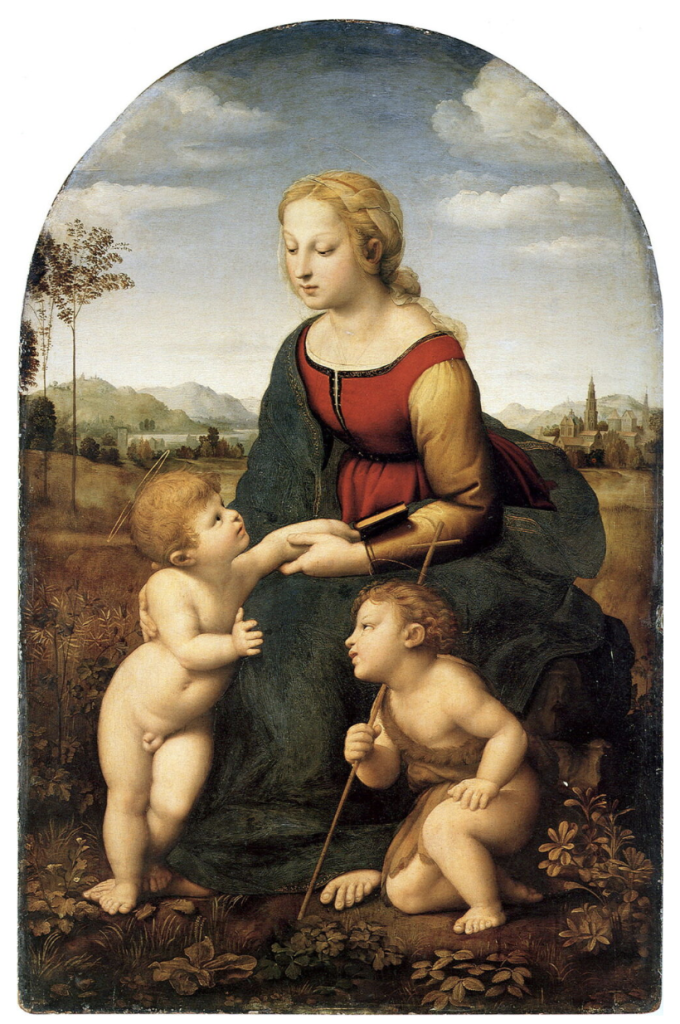
Raffaello Sanzio da Urbino, known to history simply as Raphael, was born in 1483 in Urbino, Italy, a small but culturally vibrant court city at the heart of the Italian Renaissance. The son of Giovanni Santi, a painter at the Montefeltro court, Raphael was exposed early to the ideals of humanism, proportion, and visual elegance that would shape his career. Orphaned as a child, he was placed under the care of master painter Pietro Perugino, whose graceful linear style and compositional clarity profoundly influenced Raphael’s early development. Yet it was Raphael’s ability to absorb, refine, and transcend the styles of his predecessors that would secure his place as one of the three towering figures of the High Renaissance, alongside Leonardo da Vinci and Michelangelo.
Raphael’s early works in Umbria and later in Florence revealed a young artist of extraordinary technical ability and emotional sensitivity. While in Florence, he encountered the innovations of Leonardo—particularly his use of chiaroscuro, anatomical precision, and psychological nuance. Raphael also observed Michelangelo’s monumental forms and expressive tension. Rather than mimic, Raphael synthesized: from Leonardo he took subtle modeling and atmospheric depth; from Michelangelo, sculptural dynamism and complex spatial design. Yet his work retained a serenity that was uniquely his own. By his early twenties, Raphael had become a sought-after artist, admired for his Madonnas, portraits, and devotional works that conveyed both spiritual grace and naturalistic presence.
It was in Rome, beginning in 1508, that Raphael’s genius would fully mature. Invited by Pope Julius II to fresco the private papal apartments, Raphael created some of his most enduring masterpieces, including The School of Athens, The Parnassus, and The Disputation of the Holy Sacrament. The School of Athens stands today as a visual manifesto of Renaissance humanism, uniting classical philosophy with contemporary Renaissance ideals in a symphony of architecture, geometry, and character. Figures like Plato and Aristotle are accompanied by allegorical portraits of thinkers—many modeled after Raphael’s contemporaries, such as Leonardo, Michelangelo, and perhaps even Raphael himself—thereby fusing historical reverence with personal vision.
Beyond these frescoes, Raphael produced a vast body of work during his Roman years: delicate Madonnas like The Sistine Madonna, powerfully emotive altarpieces, formal papal portraits, and commissions for religious and secular patrons. His works are marked by compositional clarity, harmony of color, and an idealized humanity that transcended individual likeness. He was also appointed chief architect of St. Peter’s Basilica in 1514, where he succeeded Donato Bramante and left a significant, though partially unrealized, architectural legacy. Raphael’s studio was highly organized and prolific—his assistants executed many works under his guidance, laying a foundation for the concept of the “workshop” as a professional studio practice.
Raphael’s contribution to art history cannot be overstated. He embodied the Renaissance ideal of the uomo universale—a well-rounded, multi-talented individual who combined intellectual rigor with artistic grace. He was celebrated in his own time not just for his artistic accomplishments, but for his diplomacy, intellect, and ability to navigate the powerful circles of Rome’s cultural elite. His compositions became templates for ecclesiastical art for centuries. More than a style, Raphael offered a model of balance—between nature and ideal, emotion and restraint, divinity and humanity.
His influence echoes well beyond his lifetime. In the centuries following his death, Raphael became the paragon of academic painting, especially within the French and Italian academies. Neoclassicists in the 18th century revered his serene clarity, while 19th-century academicians saw in him a standard of perfection against which all painting should be measured. Even Ingres, the neoclassical master, declared Raphael his supreme model. The Pre-Raphaelites, paradoxically, took his name to signify what they rejected—yet their reverence for early Renaissance clarity only highlights the polemical power Raphael’s name still carried.
In the 20th and 21st centuries, despite the shifts toward abstraction and conceptualism, Raphael’s legacy remains vital. His emphasis on composition, human dignity, and visual intelligence continues to inform artists, architects, and theorists alike. Exhibitions dedicated to his work still draw international audiences, and scholars revisit his oeuvre with fresh perspectives, especially in relation to identity, patronage, and spatial innovation.
Raphael died in 1520 at the age of just 37—his death coinciding almost symbolically with the end of the High Renaissance. He was buried in the Pantheon, an honor rarely accorded to an artist, a testament to his stature in Roman society. His epitaph, written by Pietro Bembo, reads: “Here lies Raphael, by whom Nature feared to be outdone while he lived, and when he died, feared she would die with him.” It is an apt summation. In Raphael’s work, nature and art were not at odds, but harmonized. To this day, he remains a touchstone for what visual harmony can be: not merely aesthetic balance, but a profound expression of human potential at its most luminous.